
Kinetic Novel vs Visual Novel: What’s the Difference?
A kinetic novel is a visual novel with no choices. You read one story from beginning to end, with art, music and often voices, but you never pick a menu option that changes what happens. Every player sees the same story.
So the “kinetic novel vs visual novel” question isn’t really either/or: a kinetic novel is a visual novel, just the linear kind. This guide explains where the term comes from and how kinetic novels compare with choice-based ones.
Key Takeaways
- A kinetic novel is a visual novel without choices: one fixed story.
- The term was popularised by the Japanese studio Key with Planetarian (2004).
- Kinetic novels give the author full control over pacing; choice-based VNs give the player control and replay value.
- Many otherwise branching games include kinetic chapters or epilogues.
What “Kinetic Novel” Means
“Kinetic” describes motion: the story moves forward on its own rails. The phrase “kinetic novel” was popularised by the Japanese developer Key, which used it for Planetarian (2004), a short, choice-free visual novel. The label has since become the standard way to describe any linear visual novel.
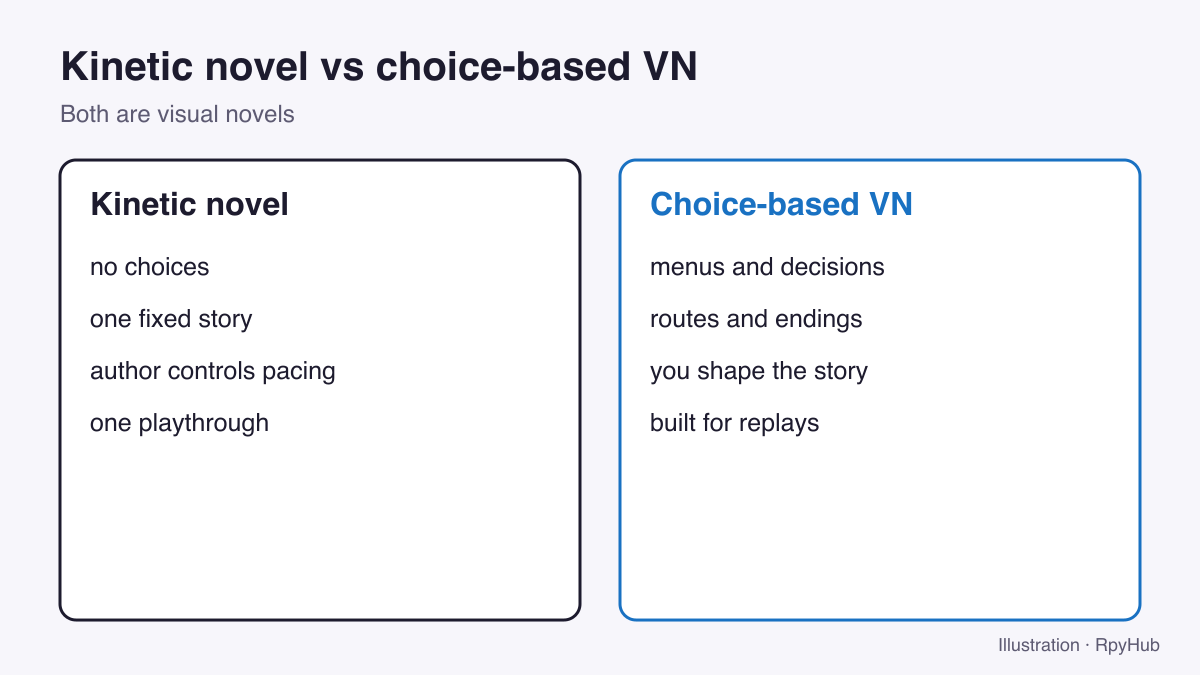
Kinetic vs Choice-Based: Side by Side
| Kinetic novel | Choice-based visual novel | |
|---|---|---|
| Choices | None | At key moments or often |
| Story | One fixed path | Routes and multiple endings |
| Pacing | Controlled by the author | Shaped partly by the player |
| Replay value | Low (re-read for enjoyment) | High (new routes, endings) |
| Length | Often short to medium | Often longer, especially with many routes |
| Walkthrough needed? | Never | Sometimes |
Why People Love Kinetic Novels
- Tighter storytelling. The writer doesn’t have to account for every possible decision, so the story can be more focused.
- No fear of missing out. You see everything; no hidden routes or bad endings.
- Great for short sessions. Pick up, read, put down. No menus to remember.
- Perfect for phones and handhelds. Tap to continue, or set auto mode and just read.
Why Some Players Prefer Choices
- Agency. Your decisions matter, which makes the story feel personal.
- Replay value. Different routes reveal different sides of characters.
- Mystery and discovery. Hidden endings and true routes reward exploration.
Kinetic Parts Inside Branching Games
Plenty of visual novels mix both approaches: a common route with choices, followed by a kinetic final chapter, or a branching story with a fixed prologue. If a game has long stretches without choices, it’s using kinetic storytelling for those parts.
How to Tell If a Game Is Kinetic
- The store page or description says “kinetic novel” or “no choices”.
- The game’s tags on VNDB mention no choices or a kinetic structure (how to use VNDB).
- Reviews mention “linear” or “one ending”.
Frequently Asked Questions
What is a kinetic novel?
A visual novel with no choices, where every reader experiences the same story.
Is a kinetic novel still a visual novel?
Yes. It uses the same format of text, art and music, just without branching.
Where does the term kinetic novel come from?
It was popularised by the Japanese studio Key with its 2004 release Planetarian.
Are kinetic novels shorter than other visual novels?
Often, but not always. Length depends on the story, not on whether there are choices.
Conclusion
A kinetic novel is a visual novel without choices: one story, told the way the author intended. Choose kinetic when you want pure storytelling; choose a branching visual novel when you want your decisions to matter.
See how other genres compare in visual novel vs dating sim vs otome, or browse the visual novel catalog.




Comments
0